Bring your VEIP paperwork
Keep the Vehicle Emissions Inspection Certificate and diagnostic report you got at the test. It shows why the car failed and gives us a head start.
 ABERDEEN
Home / Services / Emissions repair
FAILED VEIP TEST · HARFORD COUNTY, MD
Failed the VEIP test? Start here.
If your car failed Maryland’s emissions test or the check engine light is on, we find the cause, fix it with your approval, and get you ready for the retest at a VEIP station.
AFTER A FAILED VEIP TEST
Keep the Vehicle Emissions Inspection Certificate and diagnostic report you got at the test. It shows why the car failed and gives us a head start.
We read the codes, check live data and monitor status, find the root cause and give you an estimate. Approved emissions repairs get recorded on the back of your certificate, as the MVA asks.
Take the car and the completed certificate to any VEIP station. The MVA says the first retest is free if you go by the “valid through” date on your certificate.
EMISSIONS & CHECK ENGINE REPAIR
A failed emissions test almost always comes back to something the car’s computer has already noticed. Our job is to find which part or condition set it off, so you fix the problem once instead of guessing.
For the full range of engine testing, including no-start, rough running and engine repair, see engine & diagnostics.
COMMON REASONS CARS FAIL
These are the problems we see most often behind a failed OBD emissions test. Your report and our testing show which one applies to your car.
O2 and air-fuel sensors tell the engine how to mix fuel and air. A slow or failed sensor can waste fuel, raise emissions and turn on the check engine light.
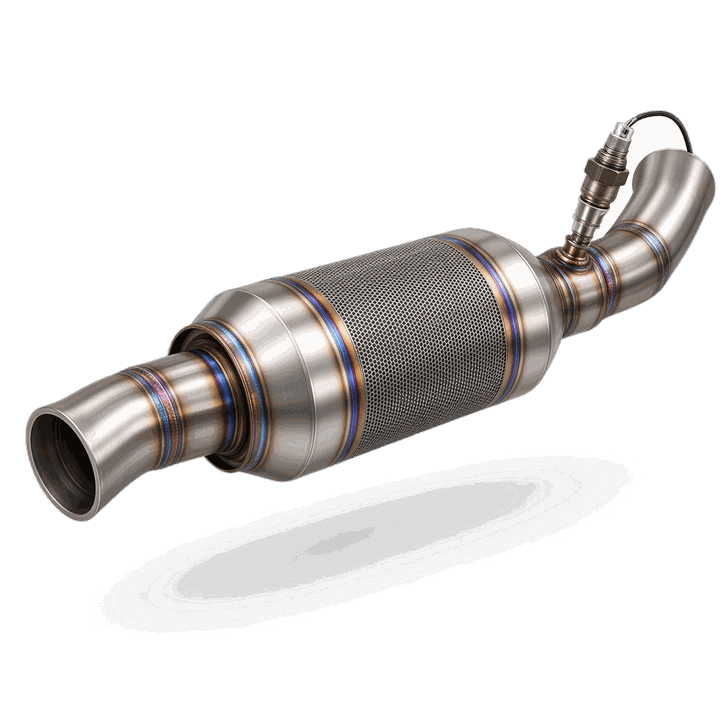
Codes like P0420 can mean a worn converter, but a bad sensor, exhaust leak or misfire can trigger the same code. We confirm the cause before recommending a converter.
The evaporative system holds fuel vapor. A loose or worn gas cap, cracked hose, or stuck purge or vent valve can set a leak code. Small leaks take testing to find.
Worn spark plugs, a weak ignition coil, a clogged injector or a vacuum leak can cause misfires. A flashing check engine light means stop driving hard and call us.
The car runs self-tests called readiness monitors. After a repair, a dead battery or cleared codes, they reset and need normal driving to finish. We can check monitor status before you retest.
If the light is on, the car will usually fail. We find the fault behind it, not just the code, and explain what it will take to fix.
This is general guidance; your vehicle’s report and test results decide the repair. The Maryland MVA explains the full process, retest timing and fees.
CHECK ENGINE CODES
These generic OBD-II codes show up most often on cars that fail the VEIP test or have readiness monitors that won’t finish. Bank 1 is the side of the engine with cylinder 1; sensor 1 sits before the catalytic converter and sensor 2 after it.
| Code | What it means | Common causes |
|---|---|---|
| P0420 / P0430 | Catalyst system efficiency below threshold (bank 1 / bank 2) | A worn catalytic converter, or an exhaust leak, faulty oxygen sensor or misfire that sets the same code |
| P0171 / P0174 | System too lean (bank 1 / bank 2) | Vacuum leak, dirty or failing MAF sensor, low fuel pressure or restricted injectors |
| P0300 | Random/multiple cylinder misfire detected | Worn spark plugs, ignition coils, vacuum leaks, fuel delivery or compression problems |
| P0301–P0308 | Cylinder 1–8 misfire detected (last digit is the cylinder) | Spark plug, coil or injector on that cylinder; sometimes low compression |
| P0440 | Evaporative emission (EVAP) system malfunction | Faulty purge or vent valve, damaged hoses or charcoal canister |
| P0442 | EVAP system small leak detected | Cracked hose, worn gas cap seal or a leaking purge or vent valve |
| P0455 | EVAP system large leak detected | Loose or missing gas cap, disconnected hose or a vent valve stuck open |
| P0456 | EVAP system very small leak detected | Gas cap seal, or a pinhole leak in a hose or seal; often found with a smoke test |
| P0457 | EVAP leak detected (fuel cap loose/off) | Gas cap not tightened, missing or the wrong cap |
| P0128 | Coolant temperature below thermostat regulating temperature | Thermostat stuck open; sometimes a coolant temperature sensor. A cold-running engine can keep monitors from finishing |
| P0133 | O2 sensor circuit slow response (bank 1, sensor 1) | Aging upstream oxygen sensor, an exhaust leak or wiring trouble |
| P0135 / P0141 | O2 sensor heater circuit malfunction (bank 1, sensor 1 / sensor 2) | Failed sensor heater, blown fuse, or damaged wiring or connector |
| P0401 | Exhaust gas recirculation (EGR) flow insufficient detected | Carbon-clogged EGR passages, a sticking EGR valve or a control problem |
| P0101 | Mass air flow (MAF) circuit range/performance | Dirty or failing MAF sensor, an air leak after the sensor or a clogged air filter |
| P0011 | Camshaft position timing over-advanced or system performance (bank 1) | Low or dirty oil, a faulty oil control solenoid or worn timing parts |
A code points to a system, not a specific part. A code reader tells you where the engine computer saw a problem, not what fixes it. One code can have several causes, so we test before we replace anything. How our engine diagnostics work ↗
GOOD TO KNOW
No. Maryland emissions tests and retests are done at VEIP stations. We diagnose and repair the problem that caused the failure, then you go back to VEIP for the retest.
P0420 means the engine computer sees the catalytic converter on bank 1 working below its efficiency threshold. A worn converter is one cause, but an exhaust leak, a faulty oxygen sensor or a misfire can set the same code, so we test before recommending a converter.
No. They are separate programs. We do Maryland safety inspections as a Maryland State Police–licensed inspection station; see state inspections. Emissions testing is handled by VEIP.
On most 1996 and newer vehicles, VEIP reads the on-board diagnostic (OBD) system. A lit check engine light or readiness monitors that have not finished usually mean the car won’t pass. We find out why the light is on.
Clearing codes also resets the readiness monitors, so the car usually can’t pass until it has been driven enough for them to finish. And if the fault is still there, the light comes back. Fixing the cause is the reliable route.
It depends on what we find. We diagnose first, explain the cause and give you an estimate. No repair starts until you approve it.
Yes. MotorXcel offers a 12-month/12,000-mile warranty. Ask us what it covers for your repair.
LET’S GET YOU BACK ON THE ROAD